

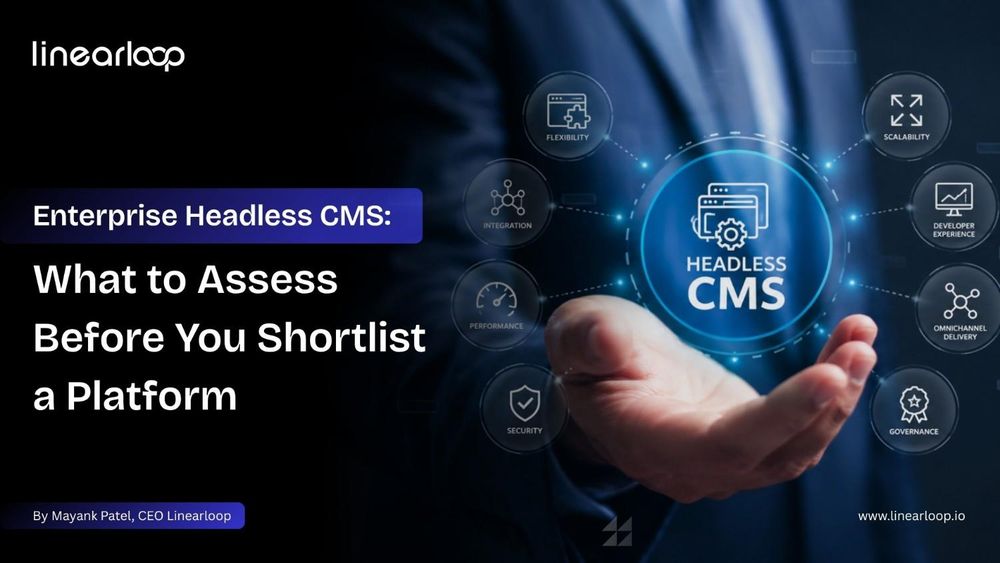
Content infrastructure has quietly become one of the more consequential decisions a technology leader makes. It rarely gets the same board-level attention as cloud strategy or cybersecurity architecture, yet the consequences of choosing the wrong platform ripple through editorial workflows, developer capacity, product release cycles, and customer-facing performance for years. For CTOs at US-based enterprises, the pressure is particularly acute. You are managing multiple stakeholders—marketing, product, legal, regional teams—while simultaneously trying to maintain a content delivery system that can scale, remain stable, and adapt to channel changes you cannot fully predict today.
The shift toward decoupled content management has accelerated across publishing, retail, financial services, and media. But acceleration does not mean clarity. If anything, the market has become noisier, with vendors making similar promises and procurement teams lacking the technical vocabulary to push back effectively. This guide is intended to cut through that noise and give CTOs a structured framework for evaluating the right platform before committing to a long-term contract.
Understanding What Separates a Headless CMS from an Enterprise-Grade One
A headless CMS separates the content repository from the presentation layer, allowing developers to pull content through APIs and render it wherever needed—web applications, mobile apps, digital kiosks, or emerging channels. This is the basic technical premise. But when organizations use the phrase enterprise headless cms, they are describing something more specific: a system that can support complex content models, multiple teams working simultaneously, strict governance requirements, and high-volume delivery without degrading in performance or reliability.
The gap between a general headless CMS and one built for enterprise use is significant. A small business might use a headless CMS to manage a blog and a product page. An enterprise uses it to manage thousands of content types across dozens of regional sites, with editorial workflows tied to legal review cycles, localization pipelines, and integration with legacy data systems. The platform that works for one will often break under the operational weight of the other.
CTOs evaluating options in this space should look closely at how a platform handles enterprise headless cms requirements specifically—not just its general feature set. The distinction matters enormously when you are managing dozens of content types, multiple editorial teams, and delivery across high-traffic channels simultaneously.
Content Modeling Depth and Flexibility
Enterprise content is rarely simple. A single product page might pull from structured data about technical specifications, regulatory language that legal has approved, localized copy managed by regional teams, and media assets hosted in a separate DAM system. A platform that cannot support nested content types, reusable components, and conditional field logic will force your editorial teams into workarounds that accumulate over time into serious technical debt.
When evaluating content modeling, ask vendors to walk through a realistic scenario from your own content operations. Can you define a content type that references another? Can fields be conditionally required based on content state? Can the same content model be reused across different projects or regions without duplicating configuration? If the answers require custom development from the vendor’s professional services team, that is a sign the platform was not built for operational complexity at scale.
API Architecture and Developer Experience
The content API is not a secondary feature—it is the primary interface for every team that builds on top of this platform. REST and GraphQL support have become table stakes, but the quality of the implementation matters more than the presence of either. Rate limits, caching behavior, query complexity restrictions, and webhook reliability will all become pain points in production environments if you do not evaluate them carefully before signing.
Developer experience also affects adoption velocity. If your front-end teams spend weeks reverse-engineering how content relationships work in the API, or if the SDK documentation is outdated and inconsistent, implementation timelines will slip and frustration will accumulate. Ask for access to sandbox environments early, and let your engineering team run their own tests before procurement decisions are finalized.
Governance, Permissions, and Workflow Controls
In an enterprise environment, content governance is not a feature request—it is a compliance requirement. Marketing teams need the ability to publish certain content independently. Legal and regulatory content needs a review and approval chain. Regional editors need access to their own markets without the ability to accidentally overwrite global defaults. A CMS that cannot support granular role-based access at the space, environment, and content-type level will become a governance liability.
This is especially relevant for organizations in regulated industries. Financial services firms, healthcare organizations, and publicly traded companies often operate under content policies that are tied to regulatory frameworks. The Federal Trade Commission’s guidance on digital content standards is one of many regulatory considerations that enterprise content teams must account for at the workflow level—not just in post-publication review.
Environment Management and Publishing Pipelines
Most enterprise CMS evaluations underestimate the importance of environment management. You need a clear separation between production content, content in staging for review, and content under active development. Some platforms handle this through branching models similar to version control in software development. Others use a simpler draft-and-publish model that quickly becomes inadequate when you have multiple simultaneous campaigns in flight.
The risk here is operational. If your content team cannot safely test changes before pushing to production, errors will reach live channels more frequently, and rollback procedures will be manual and time-consuming. Ask vendors to demonstrate how their environment model handles concurrent editorial work across teams—not just sequential publishing from one editor.
Localization and Multi-Region Content Management
For US-based enterprises operating across international markets, or even across regional markets within the United States, localization capabilities directly affect time-to-market. A CMS should support locale-specific content variants without requiring content teams to duplicate entire content trees. Translation workflows should integrate with third-party localization management systems. Fallback logic—where a missing translation defaults to the base language rather than displaying a blank field—should be configurable at the content type level.
Localization failures in production are visible to customers and can carry reputational or regulatory consequences in markets with language requirements. Evaluate this capability against real content scenarios from your own operations, not against the vendor’s demo environment.
Infrastructure Reliability and Performance Expectations
Content delivery performance is a shared responsibility between the CMS platform and the teams that implement it. But the platform’s infrastructure choices set the ceiling for what is possible. A headless CMS designed for enterprise use should be built on a globally distributed content delivery network, with clear documentation of how edge caching is managed, how cache invalidation works after content updates, and what the expected propagation delay is between a content publish event and the updated content appearing in production.
Uptime guarantees and SLA terms need to be read carefully, not taken at face value. Many vendors advertise high availability but measure uptime in ways that exclude scheduled maintenance windows, partial outages affecting specific regions, or API degradation that does not constitute a full outage. Work with your legal and procurement teams to define availability in terms that reflect your actual operational requirements before entering contract negotiations.
Disaster Recovery and Data Portability
One of the more overlooked risks in enterprise CMS procurement is what happens if you need to leave the platform. Content lock-in is a real operational risk. If your content is stored in a proprietary format that cannot be exported cleanly, or if the export tools provided are incomplete and require significant manual effort to reconstruct your content model, the cost of switching platforms in the future becomes prohibitively high.
Ask vendors to provide a complete data export in a standard format and walk through what that export looks like in practice. The ability to leave a vendor without significant data loss or structural degradation should be treated as a procurement requirement, not an afterthought.
Vendor Maturity and Long-Term Support Commitment
The headless CMS market includes platforms that are less than five years old alongside more established options. Platform maturity is not the only factor in a buying decision, but it affects the risk profile significantly. A vendor that has not yet demonstrated a stable product roadmap, consistent API versioning, or a mature support organization creates operational uncertainty that compounds over a multi-year contract.
Evaluate the vendor’s approach to breaking changes in their API. Have they maintained backward compatibility through major platform updates? Do they communicate deprecation timelines clearly and give customers sufficient runway to adapt? These questions are directly tied to your engineering team’s workload. Every breaking change that is not communicated in advance becomes an unplanned infrastructure task.
Support Models and Escalation Paths
Enterprise SLAs should include specific escalation paths, not just general support tiers. When a content outage affects a live production environment on a high-traffic e-commerce site or a regulated financial services platform, the response time matters enormously. Understand whether enterprise support means access to a dedicated technical account manager, a defined incident response procedure, or simply priority placement in a shared support queue. These are not equivalent, and the difference will matter during a production incident.
Concluding Considerations for US CTOs
Choosing a content management platform at enterprise scale is a multi-year operational commitment. The technical requirements are real, but the organizational ones are equally important. A platform that your editorial teams cannot use confidently will either be abandoned or worked around in ways that undermine the original investment. A platform that your engineering team cannot extend or integrate without significant custom development will consume capacity that should be directed elsewhere.
The evaluation process should involve stakeholders from engineering, editorial, legal, and operations. No single team sees the full picture. Procurement timelines should include sufficient time for technical validation in realistic conditions—not just vendor-led demonstrations. And contract terms should reflect the operational commitments the vendor is making, not just the features listed in a product brochure.
The right platform will not solve every content challenge your organization faces. But choosing it carefully—with a structured framework and clear requirements—will significantly reduce the likelihood of a costly replacement cycle within the next three to five years.
