

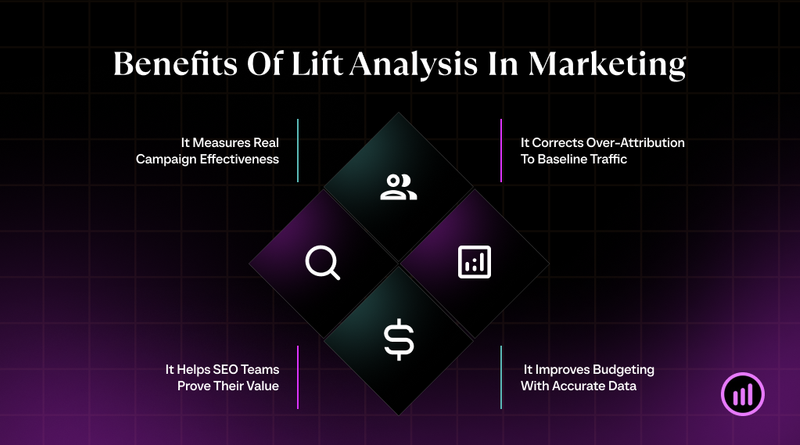
Marketing measurement has a visibility problem. The metrics that are easiest to report impressions, clicks, conversion rates, cost per acquisition — tend to dominate dashboards and strategy conversations, while the metrics that are most analytically rigorous and most useful for actual decision-making get less attention than they deserve.
Lift is one of those underutilized metrics. Understanding what is lift in marketing — what it measures, how it’s calculated, and when it should drive decisions — gives marketers a tool that standard attribution models consistently fail to provide: a reliable way to understand whether a specific marketing activity actually caused the outcomes it appears to be associated with.
The Definition and the Concept
Marketing lift measures the incremental effect of a specific marketing activity by comparing outcomes in an exposed group against outcomes in an unexposed control group. It answers the question that attribution models avoid: not “did this customer convert after seeing our ad?” but “did our ad actually cause the conversion, or would this customer have converted anyway?”
The distinction matters enormously for budget decisions. If a significant portion of the conversions attributed to a campaign would have occurred without the campaign — because those customers had high purchase intent regardless, or because they were already deep in the purchase funnel from other touchpoints — then the campaign’s true incremental value is substantially lower than the attributed metrics suggest.
Lift measurement removes this ambiguity by creating a rigorous comparison between customers who were exposed to a marketing activity and those who weren’t, holding all other factors constant.
Where Lift Testing Applies
Lift measurement is relevant across multiple marketing channels and activity types, though it’s most commonly applied in paid media, email marketing, and promotional programs.
In paid media, lift tests compare conversion rates between audiences exposed to ad campaigns and holdout groups who weren’t served the ads. The difference in conversion rate — adjusted for base rate differences between the groups — is the lift attributable to the campaign.
In email marketing, lift measurement compares outcomes between customers who received an email and a matched control group who didn’t. This reveals whether the email drove incremental revenue or simply reached customers who would have purchased anyway.
In promotional programs, lift testing measures whether a discount or offer produced incremental sales or primarily subsidized purchases that would have occurred at full price — a distinction with direct implications for promotional profitability.
Why Standard Attribution Fails to Capture True Lift
Standard attribution models — last-click, first-click, linear, time-decay — all share a fundamental limitation: they assign credit based on correlation, not causation. A customer who was served a retargeting ad and subsequently converted may have converted because of the ad, or may have been going to convert regardless and simply happened to see the ad on the way to a purchase they’d already decided to make.
Attribution models can’t distinguish between these scenarios because they don’t have a counterfactual — a comparison group of equivalent customers who weren’t exposed to the same touchpoint. Lift measurement creates this counterfactual deliberately, enabling genuine causal inference rather than correlation-based credit assignment.
FAQs
How is lift calculated mathematically?
Lift is typically expressed as the percentage difference in conversion rate between the exposed group and the control group: (exposed conversion rate − control conversion rate) / control conversion rate × 100.
What’s a good lift percentage for a paid media campaign?
Lift benchmarks vary significantly by channel, industry, and campaign type. Single-digit percentage lift on a large campaign can represent substantial incremental revenue; context and absolute value matter more than the percentage alone.
How large does a test group need to be for lift measurement to be statistically valid?
Sample size requirements depend on the expected conversion rates and the minimum detectable lift. Statistical significance calculators can determine required sample sizes for specific testing scenarios.
Can lift be measured for brand awareness campaigns, not just conversion-focused ones?
Yes — brand lift studies measure the incremental effect of brand campaigns on awareness, recall, consideration, and purchase intent metrics, typically through survey methodology with exposed and control groups.
How often should we conduct lift tests?
For significant marketing activities — major channel investments, large promotional programs, new creative approaches — lift testing should be a standard component of the measurement plan rather than an occasional validation exercise.
