

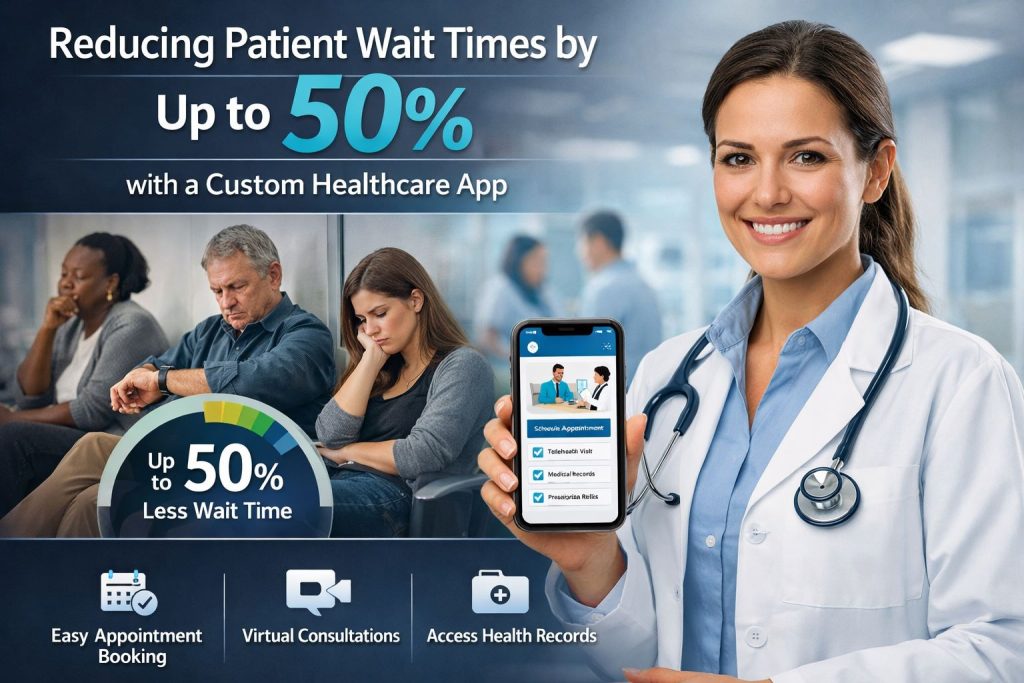
Long patient wait times always remain one of the most frustrating aspects of modern healthcare. Even with scheduled appointments, patients mostly spend significant time waiting due to inefficient scheduling, manual processes, along with poor patient flow management. For healthcare providers, scheduling, manual processes, and poor bottlenecks lead to overlooked staff and reduced patient satisfaction.
That’s exactly where custom healthcare apps are making a real impact. By digitalizing appointment scheduling, patient registration, and real-time queue management, these solutions can cut wait times by 40 – 50% and improve overall hospital efficiency.
In this guide, we’ll explore the reasons for long wait times, the limitations of traditional systems, and how healthcare apps streamline patient flow for faster, even more efficient care.
The Patient Flow Crisis: Why Waiting Rooms Are Always Full
At first glance, a full-waiting room can be viewed as a natural consequence of a large patient flow. Nevertheless, the actual problem is usually the way in which patients circulate within healthcare establishments. Hospitals have a chain of interrelated processes, which include registration, triage, consultation, diagnostics, and billing. Any slowing down of any of these stages causes a wave throughout the system.
Even simple delays in the registration or retrieval of patient records can soon become bottlenecks in the entire system. Outpatient departments (OPDs) are usually congested, with patients waiting longer than expected, as there is no clear visibility of the position that patients are in the process. These inefficiencies are further increased as the patient demand keeps rising and staffing levels are at a minimum.
Consequently, the waiting rooms accumulate not due to the lack of physicians, but because the outdated systems of patient management would require a lack of coordination and real-time information to provide patients with a seamless experience during the care process.
Why Traditional Appointment and Queue Systems Lead to Long Wait Times
Several hospitals still depend on outdated appointment and queue management systems that were never actually designed for today’s patient volumes. Although these systems schedule appointments, they mostly fail in order th manage the entire patient journey, which results in delays and overcrowded waiting rooms:
- Static Appointment Scheduling: Numerous hospitals utilize fixed appointment slots that don’t adjust to real-time conditions like delayed consultations or emergency cases. Now, this leads to overbooking and longer patient queues.
- Manual Patient Intake Processes: Patients generally complete registration and forms at the hospital itself, slowing down the entry process and creating congestion at reception desks.
- Paper-Based Medical Records: Doctors mostly spend valuable consultation time searching through files or even waiting for reports, which lessens the number of patients they can see efficiently.
- Poor Department Coordination: Limited communication between consultation rooms, diagnostics, and pharmacies causes workflow interruptions and unnecessary patient delays.
- Lack of Data-Driven Scheduling: Without analytics or intelligent scheduling systems, hospitals struggle in order to optimize appointments and manage patient flow effectively.
Key Insight: Most healthcare systems focus on managing appointments, but not the entire patient flow, and this gap is one of the main reasons long wait times persist.
How Long Wait Times Hurt Hospital Performance and Revenue
Long patient wait times don’t just frustrate visitors. Beyond that, they directly impact a hospital’s performance, reputation, and financial stability. What actually can seem like a scheduling issue mostly turns into a much larger operational challenge. Here’s how it hurts the performance and revenue of any hospital:
- Declining Patient Trust and Retention: When patients repeatedly face delays, their confidence in the healthcare provider weakens. Over time, they can switch to competitors who are offering faster and even more streamlined services.
- Reduced Staff Productivity: Doctors and administrative teams spend excessive time managing queues, managing paperwork, and resolving scheduling conflicts rather than focusing on quality patient care.
- Lost Consultation Capacity: Inefficient workflows limit the number of patients doctors can see daily, and reduce overall service output and revenue potential.
- Higher Operational Costs: Manual administrative processes need more staff and time, and increase labor costs without even improving efficiency.
- Scaling Challenges: Hospitals can’t expand services effectively if foundational workflow inefficiencies remain unresolved. Growth without system improvement only magnifies the issue.
Reimagining Patient Flow with Custom Healthcare Apps
Custom healthcare applications digitize the whole journey of the patient, from online appointment booking and digital registration to follow-ups and feedback.
Through real-time scheduling engines, automated check-ins, along with smart patient flow management, hospital management systems (HMS), electronic health records (EHR), and telemedicine platforms transform fragmented workflows into a unified and data-driven patient management ecosystem that enhances efficient and care delivery.
Intelligent Features That Actually Reduce Wait Times
AI-Driven Appointment Optimization
AI scans previous consultation patterns in order to predict durations and schedule appointments even more accurately, and reduce overbooking and unnecessary delays. And, this balanced scheduling improves patient distribution across time slots and enhances overall workflow efficiency.
Digital Pre-Registration and Smart Check-In
Patients submit medical details and forms digitally before even arrival, and speed up in-hospital registration and verification processes. Automated check-ins prevent repetition, congestion and allow staff in order to keep their focus on patient care.
Real-Time Queue Transparency
Patients track their live queue status through the application, and reduce uncertainty and frustration during waiting periods. Better visibility prevents overcrowding and supports smoother patient movement inside facilities.
Integrated Medical Records Access
Doctors access centralized electronic health records immediately, and eliminate delays that are caused by manual file retrieval. Faster information access shortens consultation and increases daily patient capacity.
Telehealth for Non-Critical Consultations
Virtual consultations manage routine follow-ups and minor cases remotely, and reduce unnecessary hospital visits. Furthermore, lower physics-based footfall improves availability and significantly decreases waiting times overall.
A Day in the Life: How a Custom Healthcare App Streamlines Patient Flow
| Stage | Traditional Experience | With Custom Healthcare App |
| Appointment Booking | Phone calls and manual scheduling | Smart online scheduling |
| Registration | Paper forms and long queues | Digital pre-registration |
| Waiting Time | Uncertain and unpredictable | Real-time queue tracking |
| Doctor Consultation | Delays due to missing data | Instant patient records |
| Follow-up Care | Manual scheduling | Automated reminders |
Outcome
- 40–50% reduction in waiting times
- Better doctor utilization
- Faster patient throughput
- Improved overall care experience
Building a High-Performance Healthcare App with Mypcot Infotech
Developing a high-performance healthcare app truly needs more than basic development skills. Actually, it demands expertise in healthcare workflows. AI systems, compliance standards, and secure digital infrastructure. Mypcot Infotech delivers custom healthcare solutions that are specially designed to streamline patient flow and significantly reduce wait times.
Core Solution Areas:
- Smart Appointment Management: AI-driven scheduling systems optimize the doctor’s availability, prevent overbooking, and balance patient distribution across time slots effectively.
- Telemedicine Platforms: Secure virtual consultation systems reduce physical hospital visits, manage patient load efficiently, and improve healthcare accessibility.
- Electronic Health Record (EHR) Integration: Centralized digital records provide instant access to a patient’s history, minimize delays, and improve overall clinical coordination.
- AI-Powered Analytics: Advanced data analytics deliver actionable insights, enabling hospitals to optimize workflows, predict demand, and enhance operational performance.
Conclusion
Reducing patient wait times is no longer just a service improvement. Over and above that, it’s a strategic necessity for modern healthcare providers.
By implementing custom healthcare apps with smart scheduling, real-time tracking, and some of the AI-driven insights, hospitals can significantly improve efficiency and patient satisfaction.
So, partnering with an experienced AI app development company like Mypcot Infotech ensures that your digital transformation is totally secure, scalable, and built to deliver measurable results.