

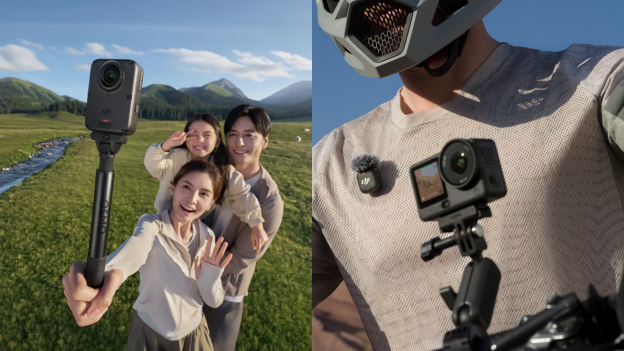
When you are skiing down a mountain, cycling through a forest, diving into the ocean, or simply documenting a trip, the camera you choose changes not only what you record but also how you experience the moment. Two of the most popular compact options today are action cameras and 360 cameras. Both are built for immersive shooting, but they solve different problems.
A 360 camera captures more of the scene around you. An action camera, on the other hand, is usually better at turning the scene in front of you into footage that is immediately usable. So which one really captures more of the moment? The answer depends on whether you value total coverage or focused storytelling.
What an Action Camera Does Best
A traditional action camera records in a defined direction with an ultra-wide field of view. That may sound less flexible than recording everything around you, but it has an important advantage: what you frame is essentially what you get.
For creators who want to shoot, transfer, edit, and publish quickly, that direct workflow is hard to beat. It is particularly useful for cycling, skiing, surfing, diving, hiking, POV filming, and travel vlogging. You spend less time reframing footage later and more time actually enjoying the activity.
DJI’s latest Osmo Action 6 shows how far the category has developed. It uses a 1/1.1-inch square CMOS sensor and, unusually for an action camera, a variable f/2.0-f/4.0 aperture. The square sensor also gives creators more flexibility to crop footage for horizontal or vertical platforms. It can record up to 8K/30fps in supported modes, while 4K/120fps is available for high-frame-rate action. RockSteady stabilization and 4K HorizonSteady help keep fast-moving footage watchable even when the camera itself is moving aggressively.
For outdoor use, the practical details matter just as much. Osmo Action 6 is waterproof to 20 meters without an additional case, has 50GB of built-in storage, and offers up to four hours of operating time under DJI’s test conditions. Those features make it especially convenient for long days outdoors, where stopping to manage storage, batteries, or protective housings can mean missing the shot.
If this straightforward, rugged style of shooting fits your needs, choosing an action camera is often the more practical route.
Where a 360 Camera Wins
A 360 camera uses lenses facing in different directions to record the environment around the camera and stitch it into spherical footage. Its biggest advantage is obvious: you do not have to decide exactly where the camera should point while you are recording.
That makes 360 cameras excellent for unpredictable situations. Mount one on a ski pole, motorcycle, bicycle, or selfie stick and you can choose the final viewing direction afterward. Reframing can create third-person views, sweeping pans, tiny-planet effects, and angles that would be difficult to capture with a conventional camera.
DJI Osmo 360 is a strong example. It uses a 1/1.1-inch CMOS sensor with an f/1.9 aperture and records panoramic video at up to 8K/50fps. It can also capture 120MP panoramic stills. The camera includes 128GB of built-in storage, with 105GB available for use, and supports microSD cards up to 1TB. For creators who want maximum freedom to choose the composition after recording, that is a compelling toolkit.
There are established competitors in this category as well. Insta360 X5, for example, records 8K 360 video and uses 1/1.28-inch sensors. It is waterproof to 15 meters without a case and provides a mature reframing workflow. It remains a capable option, particularly for users already invested in the Insta360 ecosystem.
However, the flexibility of 360 capture comes with a trade-off: more decisions are moved into post-production. You often need to reframe the footage, choose camera angles, set keyframes, and export a conventional flat video before it is ready to share. For creators who enjoy editing, that can be part of the fun. For someone who simply wants clean footage of a ride, dive, or hike, it can feel like an extra step.
Image Quality and Low-Light Shooting
Resolution numbers can be misleading when comparing these two categories. An 8K 360 recording spreads those pixels across an entire spherical view. Once you crop a relatively small section into a normal frame, the effective detail is lower than the headline resolution might suggest.
An action camera dedicates its recorded pixels to the view you actually intend to use. This can give conventional footage a more direct, detailed look without requiring aggressive reframing.
Osmo Action 6 also has an advantage in changing light. Its f/2.0-f/4.0 variable aperture can open wider when more light is needed, while its 1/1.1-inch sensor is designed for high-dynamic-range and low-light capture. For dawn rides, evening city walks, shaded trails, or mixed indoor-outdoor scenes, that flexibility is useful in everyday shooting rather than just on a specification sheet.
Which One Should You Choose?
Choose a 360 camera if you frequently wish you could change the camera angle after the moment has already happened. It is particularly useful for solo creators, unusual mounting positions, virtual tours, immersive travel footage, and highly stylized social content.
Choose an action camera if you care more about durability, fast operation, predictable framing, and footage that is ready to use with minimal editing. For most sports, travel, underwater shooting, and POV content, that simpler workflow is likely to be more valuable on a daily basis.
And if you want the flexibility of both formats, DJI now offers a convincing path on either side. Osmo 360 handles immersive capture when you truly need to record everything around you, while Osmo Action 6 is the more natural everyday choice when the goal is to capture the moment clearly, stabilize it reliably, and move on to the next adventure.
Ultimately, a 360 camera captures more around the moment. A well-designed action camera often captures more of the moment you actually want to remember.
