

In today’s fast-paced digital world, organizations across industries are turning to artificial intelligence (AI) to improve operational efficiency and decision-making. One of the most impactful applications of AI lies in case management—a domain that demands precision, speed, and collaboration across departments.
AI-driven systems are revolutionizing how teams handle complex cases, from customer support to compliance investigations and service requests. By automating manual processes and providing intelligent insights, AI helps teams close cases faster, improve accuracy, and deliver better outcomes.
To understand how this transformation is taking shape, it’s important to explore the growing role of AI in Case Management and how intelligent orchestration platforms like ZBrain are powering this evolution.
The Growing Importance of AI in Case Management
Why traditional case management falls short
Conventional case management systems often rely heavily on manual data entry, email communication, and static workflows. This leads to inefficiencies such as duplicated work, lack of visibility into case progress, and delayed resolutions.
In industries like banking, insurance, healthcare, and public services—where timely resolution and compliance are critical—such inefficiencies can lead to customer dissatisfaction, financial losses, and even regulatory risks.
The AI advantage
AI addresses these limitations by automating repetitive processes, enhancing data accuracy, and enabling real-time insights. It empowers organizations to manage high case volumes while maintaining quality and compliance.
From automatically classifying incoming cases to predicting resolution timelines, AI enables smarter, faster, and more consistent case handling.
Key Benefits of AI-Powered Case Management
1. Automated data extraction and classification
AI models can scan documents, emails, and forms to extract relevant information automatically. This reduces manual effort and human errors while ensuring data consistency across systems.
2. Intelligent case routing
Machine learning algorithms analyze case attributes and route them to the most suitable agent or department. This not only accelerates resolution but also optimizes resource utilization.
3. Predictive insights and analytics
AI can identify patterns in historical data to predict case outcomes, identify risks, and provide proactive recommendations. For instance, in a financial services context, AI can flag potential fraud or compliance issues early.
4. Enhanced collaboration
By integrating with communication tools and knowledge bases, AI systems ensure that teams have the right context and information at every step of the case lifecycle. This improves collaboration and transparency.
5. Continuous learning
AI systems improve over time through feedback loops, learning from past cases to refine predictions and automate more complex decision-making.
How ZBrain Enables Intelligent Case Management
Orchestrating AI agents for seamless automation
While standalone AI tools can automate parts of the process, true transformation requires orchestration—bringing multiple AI agents together to work in harmony. This is where ZBrain Builder makes a difference.
ZBrain Builder allows organizations to design, customize, and deploy intelligent AI workflows without deep technical expertise. It connects large language models (LLMs), data sources, and enterprise systems into cohesive automation pipelines.
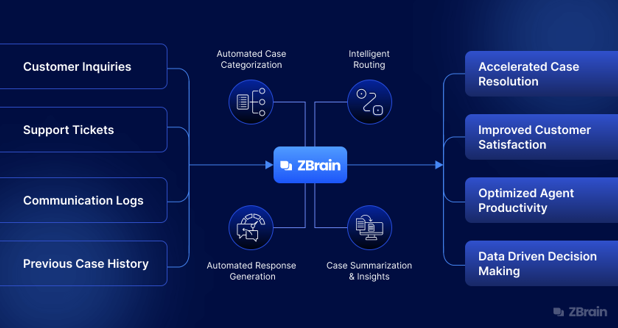
For case management, this means you can create AI agents that automatically:
- Classify and prioritize cases based on urgency and context.
- Extract relevant data from case documents or communications.
- Validate case details against internal knowledge bases or policies.
- Generate summaries, reports, or customer responses using natural language.
By orchestrating these intelligent agents, enterprises can achieve a new level of operational efficiency, reducing case resolution times and improving service quality.
Real-World Applications Across Industries
Banking and financial services
AI agents can automate fraud case reviews, loan application validation, and dispute resolution processes, ensuring compliance and faster turnaround times.
Healthcare
Hospitals and insurers use AI-driven case management to handle patient claims, medical record analysis, and incident reporting while ensuring data privacy and accuracy.
Public sector and legal services
Government agencies and legal teams leverage AI for document-heavy processes like grievance redressal, legal discovery, and compliance case tracking.
Customer support
AI helps support teams automatically analyze customer issues, suggest resolutions, and escalate critical cases—enhancing satisfaction and reducing response time.
Building a Future-Ready Case Management Ecosystem
The future of case management lies in combining human expertise with AI-driven intelligence. Instead of replacing human decision-making, AI augments it—allowing teams to focus on strategic and high-value tasks while machines handle routine operations.
To make this possible, organizations need a flexible and scalable platform that connects data, models, and processes. ZBrain’s orchestration-first approach provides this foundation, ensuring seamless integration between AI agents, legacy systems, and real-time data flows.
Conclusion
AI is no longer a futuristic concept—it’s a core enabler of efficient, accurate, and proactive case management. By adopting AI-powered solutions, enterprises can streamline workflows, strengthen compliance, and deliver superior customer experiences.
Platforms like ZBrain are at the forefront of this change, empowering businesses to design intelligent, domain-specific AI agents that drive measurable impact.
As more organizations embrace AI in Case Management, they are not just improving operations—they are building smarter, more resilient enterprises for the AI-driven future.
Read also: Iceporncasting: The Chilling Art of Frozen Visual Storytelling
